How to Run Everytime Is Made Active Again Unity
Updated March 2020. xv min read
What y'all volition get from this page: Updated scripting functioning and optimization tips from Ian Dundore that reverberate the development of Unity's architecture to support data-oriented pattern.
Unity'southward evolving, and the old tricks might no longer be the all-time ways to squeeze performance out of the engine. In this commodity, you'll become a rundown of a few Unity changes (from Unity 5.10 to 2019.x) and how y'all can accept reward of them.
Scripting performance office I
I of the most hard tasks during optimization is choosing how to optimize code once a hot spot has been discovered. Many factors are involved: platform-specific details of the operating organisation, CPU, and GPU; threading; retentiveness access; distribution of input data; parameters that need scaling, and others. It's difficult to know in advance which optimization will produce the biggest existent-world benefit.
Generally, it'southward a good idea to prototype optimizations in small test projects – you can iterate much faster. However, isolating lawmaking into a test project poses its ain challenge: simply isolating a piece of code changes the surround in which it runs. Thread timings may differ; the managed heap may be smaller or less fragmented. Therefore, you must be careful in designing your tests.
Get-go by because the inputs to your code and how the code reacts when y'all modify its inputs.
- How does it react to highly coherent data that'due south located serially in retention? How does it handle cache-incoherent data?
- How much code have you removed from the loop in which your code runs? Have you contradistinct the usage of the processor's education cache?
- What hardware is it running on? How well does that hardware implement branch prediction? How well does information technology execute micro-operations out of order? Does information technology have SIMD support?
- If you have a heavily multithreaded organization and it's running on more cores versus fewer, how does the system react?
- What are the scaling parameters of your lawmaking? Does it scale linearly as its input set grows, or more than than linearly?
Effectively, you must recall about exactly what your examination harness measures.
Implications: Sample test
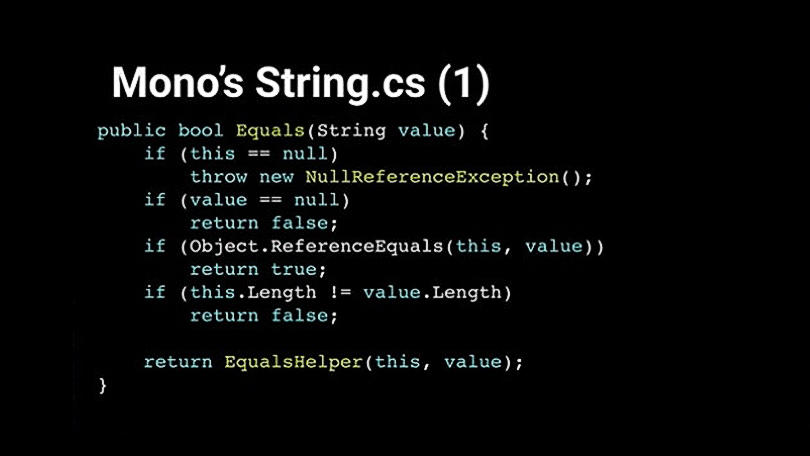
As an instance, consider the post-obit test of a uncomplicated functioning: comparing two strings (see image higher up).
When the C# APIs compare two strings, they do locale-specific conversions to ensure that different characters friction match their counterparts from different cultures and you'll notice that is pretty slow.
While most string APIs in C# are culture-sensitive, one is not: String.Equals.
If you open Cord.CS from Unity'south Mono GitHub and look at String.Equals, you see a very simple function. It performs a couple of checks before passing control to a function called EqualsHelper, a individual part that you cannot call directly without C# reflection.
EqualsHelper is a elementary method. It walks through the strings iv bytes at a time, comparing the raw bytes of the input strings. If information technology finds a mismatch, it stops and returns faux.
But in that location are other ways to check for cord equality. The near innocuous-looking is an overload of String.Equals that accepts ii parameters: the string to compare against, and an enum called StringComparison.
The single-parameter overload of String.Equals does but a little work earlier passing command to EqualsHelper. So what does the ii-parameter overload do?
The two-parameter overload'due south code performs a few boosted checks before inbound a large switch argument. This statement tests the value of the input StringComparison enum. Since we're seeking parity with the single-parameter overload, nosotros want an ordinal comparison – a byte-by-byte comparison. In this case, control volition period by 4 checks before arriving at the StringComparison.Ordinal case, where the code then looks very similar to the single-parameter String.Equals overload. This ways that if you used the two-parameter overload of Cord.Equals instead of the single-parameter overload, the processor would perform a few extra comparison operations. One could expect this to be slower, but information technology's worth testing.
You don't desire to stop at testing just String.Equals when you are interested in all the means to compare strings for equality. There is an overload of String.Compare which can perform ordinal comparisons, as well as a method called String.CompareOrdinal which itself has ii different overloads.
Encounter function II for more than!

Scripting performance function Ii
As a reference implementation, let'southward besides write a simple paw-coded example. It'south simply a little function with a length bank check that iterates over each character in the 2 input strings and checks if each is equal.
After examining the code for all of these, there are four different test cases that seem immediately useful:
- Two identical strings, to test worst-instance performance.
- Two strings of random characters but of identical length, to bypass length checks.
- 2 strings of random characters and identical length with an identical first character, to featherbed an interesting optimization found only in String.CompareOrdinal.
- Two strings of random characters and differing lengths, to exam best-case performance.
After running a few tests, String.Equals is the clear winner. This remains true regardless of platform, or scripting runtime version, or whether nosotros're using Mono or IL2CPP.
It's worth noting that String.Equals is the method used by the string equality operator, ==, so don't run out and modify a == b to a.Equals(b) all over your lawmaking!
Actually, examining the results, it's odd how much worse the hand-coded reference implementation is. Examining the IL2CPP code, we can see that Unity injects a bunch of assortment bounds checks and nada checks when our code is cross-compiled.
These can be disabled. In your Unity install folder, discover the IL2CPP subfolder. Inside that IL2CPP subfolder, yous'll notice IL2CPPSetOptionAttributes.cs. Elevate this into your project, and yous'll get access to the Il2CppSetOptionAttribute.
You can decorate types and methods with this aspect. You can configure it to disable automated null checks, automatic array bounds checks, or both. Sometimes this tin can speed up code by a substantial amount. In this particular test case, it speeds upwards the hand-coded string comparison method by about xx%.
Transforms
Transform component is one of the systems used past the greatest number of other systems in Unity, such as Animation, Physics, UI, Rendering. Since Unity 2017.4 and 2018.i, the Transform organization is built on top of two key concepts: TransformHierarchy and TransformChangeDispatch.
If we examine the memory layout of a Unity scene, each root Transform would correspond to a contiguous data buffer. This buffer, called a TransformHierarchy, contains data for all of the Transforms below a root Transform. We pack transform data into TransformHierarchy so that we can perform Transform calculations efficiently. For example, when calculating the globe position of a GameObject, having all local translation / rotation / scaling Transform data packed in one well laid-out data structure improves performance by minimizing enshroud misses.
In addition, a TransformHierarchy also stores metadata about each Transform it contains. This metadata includes a bitmask to rail which of Unity's other systems is interested in changes to a specific Transform. It also includes a bitmask which indicates whether a Transform is "dirty" for a specific system – if the Transform's position, rotation, or scale has changed since the last time the Transform was marked equally being "clean" by that system.
With this information, Unity can now create a list of muddied Transforms for each of its other internal systems. The system that handles these queries for dirty Transforms in a multithreaded manner is called TransformChangeDispatch. For case, the Physics system can query TransformChangeDispatch to fetch a list of Transforms whose data have changed since the last fourth dimension the Physics organisation ran a FixedUpdate.
However, to assemble this list of changed Transforms, TransformChangeDispatch should not iterate over all Transforms in a scene. That would become very boring if a scene independent a lot of Transforms – especially since, in many cases, very few Transforms would have changed.
To ready this, TransformChangeDispatch tracks a list of dirty TransformHierarchy structures. Whenever a Transform changes, it marks itself as dirty, marks its children as dirty, and and so registers its TransformHierarchy to TransformChangeDispatch. When some other organisation within Unity requests a list of changed Transforms, TransformChangeDispatch iterates over each Transform in each dirty TransformHierarchy structure. Transforms with the appropriate dirty bits set are added to a list and this listing is returned to the system making the request.
Because of this architecture, the more y'all divide your hierarchy, the better you make Unity'south power to track changes at a granular level. Although it may be acceptable to have a large hierarchy of Transforms that never alter, having a constantly changing Transform within a mostly static hierarchy would sometimes force Unity to do meaning useless scanning.
Moreover, TransformChangeDispatch uses Unity's internal multithreading arrangement to separate up the work it needs to do when examining TransformHierarchy structures, and the smallest unit of a work item is per hierarchy. And then splitting hierarchy into reasonable-sized chunks could also make your programme more multi-threaded.
The scanning for dirty flags across TransformHierarchy structures incurs some overhead each fourth dimension a organisation needs to request a listing of changed Transforms from TransformChangeDispatch. Most of Unity's internal systems asking updates one time per frame, immediately earlier they run. For case, the Blitheness system requests updates immediately before information technology evaluates all the active Animators in your scene. Similarly, the rendering system requests updates for all active Renderers in your scene before it begins culling the list of visible objects.
The physics organization works differently than the other systems. Since Unity 2017.2, Unity'southward physics organization works on top of TransformChangeDispatch. Whatsoever fourth dimension you perform a Raycast, Unity would need to query TransformChangeDispatch for a listing of changed Transforms and apply them to the physics globe. That could be expensive, depending on how big your Transform Hierarchies were and how your code called physics APIs. However, if we skip the TransformChangeDispatch query, the Raycast might exist performed on out-of-date data.
Unity offers users the ability to selection which behaviour the Editor should cull using the Physics.autoSyncTransforms setting. This can exist specified either in your physics settings in the Unity Editor or at runtime by setting the Physics.autoSyncTransforms belongings.
From Unity 2017.2 to Unity 2018.2, Physics.autoSyncTransforms defaults to truthful. In this case, Unity will automatically synchronize the physics world to Transform updates each time you call a physics query API like Raycast or Spherecast.
From Unity 2018.3 onwards, Physics.autoSyncTransforms defaults to imitation. In this case, the physics system volition only query the TransformChangeDispatch arrangement for changes at ii specific times: immediately before running FixedUpdate, where physics simulation is performed, and (if there is any rigidbody performing RigidbodyInterpolation) before Update, where the interpolated physics simulation result is written back into the Unity scene.
Setting Physics.autoSyncTransforms to false will eliminate spikes due to TransformChangeDispatch and Physics scene updates from Physics queries. However, changes to Colliders will not exist synchronized into the Physics scene until the adjacent FixedUpdate. This means that if yous disable autoSyncTransforms, move a Collider and so call Raycast with a Ray directed at the Collider'south new position, the Raycast might non hit the Collider. This is considering the Raycast is operating on the terminal-updated version of the physics scene which has not yet been updated with the Collider's new position.
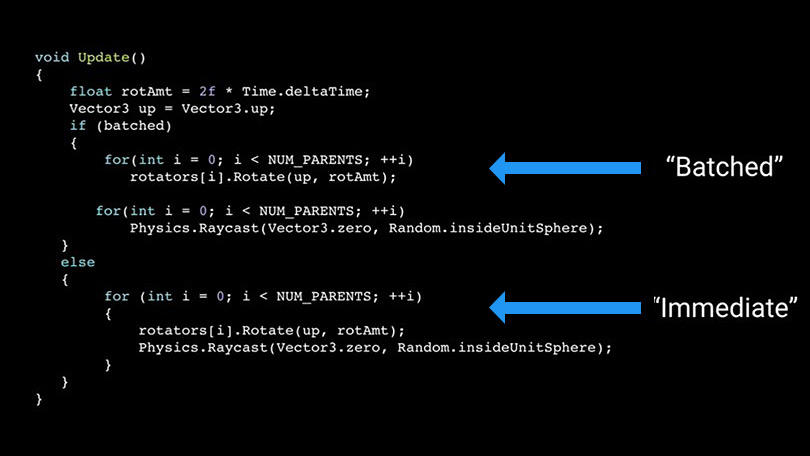
This can result in some issues in your project. Before you perform any physics organisation query such every bit Raycast, you tin can call Physics.SyncTransforms to force the physics system to synchronize the physics world with the Unity scene. A recommended approach is phone call Physics.SyncTransforms once and then perform all of your physics queries in a batch.
The instance in a higher place illustrates the difference betwixt scattered and batched physics query.
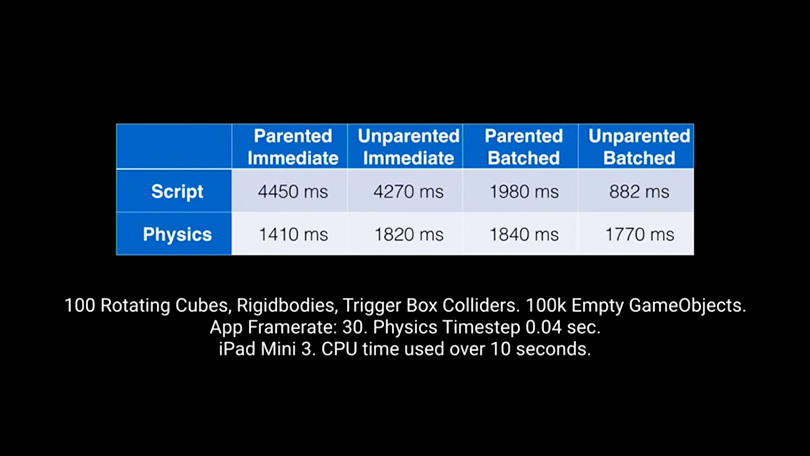
Transforms: operation of scattered vs batched physics query
The performance departure between these two examples is hitting and becomes even more dramatic when a scene contains only modest Transform hierarchies (come across example to a higher place).
Furthermore, if your project has a lot of raycast tasks, consider batching your physics queries together into a task through, for instance, the RaycastCommand API. This allows your code to run outside of the main thread in parallel. Note that before you schedule a RaycastCommand job and if Physics.autoSynctransform is set up to simulated, you would withal need to telephone call Physics.SyncTransforms to ensure your scene is up to date.
If yous have a C# subsystem that needs to access TransformChangeDispatch from the script, the merely way is through the Transform.hasChanged property, which is built internally on top of the TransformChangeDispatch system. After gathering the list of changed transforms from the main thread in this fashion, you can go through these transforms through a chore using the IJobParallelForTransform API.

The Sound arrangement
Internally, Unity uses a system chosen FMOD to play AudioClips. FMOD runs on its own threads, and those are responsible for decoding and mixing sound together. Nonetheless, audio playback isn't entirely free. At that place is some work performed on the main thread for each Audio Source active in a scene. Also, on platforms with fewer numbers of cores (such every bit older mobile phones), it'south possible for FMOD's audio threads to compete for processor cores with Unity's main and rendering threads.
On each frame, Unity loops over all active Audio Sources. For each Audio Source, Unity calculates the distance between the audio source and the active audio listener, and a few other parameters. This information is used to calculate book attenuation, doppler shift, and other effects that tin impact individual Audio Sources.
A common issue comes from the "Mute" checkbox on an Audio Source (see image above). You might think that setting Mute to truthful would eliminate any computation related to the muted Audio Source – but information technology doesn't!
Instead, the "Mute" setting merely clamps the Volume parameter to naught, after all other Volume-related calculations are performed, including the distance cheque. Unity will also submit the muted Sound Source to FMOD, which will then ignore it. The calculation of Audio Source parameters and the submission of Audio Sources to FMOD volition testify up as AudiosSystem.Update in the Unity Profiler.
If y'all discover a lot of time allocated to that Profiler marker, cheque to meet if you have a lot of active Audio Sources which are muted. If they are, consider disabling the muted Audio Source components instead of muting them, or disabling their GameObject. You tin also phone call AudioSource.Stop, which will stop playback.
Some other thing you tin can do is clamp the vocalism count in Unity's Audio Settings. To do this, you lot can call AudioSettings.GetConfiguration, which returns a structure containing two values of interest: the virtual voice count, and the real voice count.
Reducing the number of Virtual Voices volition reduce the number of Audio Sources which FMOD will examine when determining which Audio Sources to actually play back. Reducing the Real Voice count will reduce the number of Audio Sources which FMOD actually mixes together to produce your game'due south sound.
To alter the number of Virtual or Real voices that FMOD uses, you should change the appropriate values in the AudioConfiguration structure returned by AudioSettings.GetConfiguration, then reset the Audio organization with the new configuration by passing the AudioConfiguration structure equally a parameter to AudioSettings.Reset. Annotation that this interrupts audio playback, so do this when players won't find the change, such as during a loading screen or at startup time.
Animations
There are two different systems that can be used to play animations in Unity: the Animator system and the Blitheness system.
By "Animator system" we mean the organisation involving the Animator component, which is attached to GameObjects in order to animate them, and the AnimatorController asset, which is referenced by one or more Animators. This system was historically called Mecanim.
In an Animator Controller, you ascertain states. These states can be either an Blitheness Prune or Alloy Tree. States tin can be organized into Layers. For each frame, the active state on each Layer is evaluated, and the results from each agile Layer are blended together and applied to the animated model. When transitioning between two states, both states are evaluated.
The other system is one nosotros phone call the "Animation organization" and it's represented by the Animation component.. Each frame and each agile Animation component linearly iterates through all the curves in its attached Animation Clip, evaluates those curves, and applies the results.
The difference between these ii systems is not just features, simply too underlying implementation details.
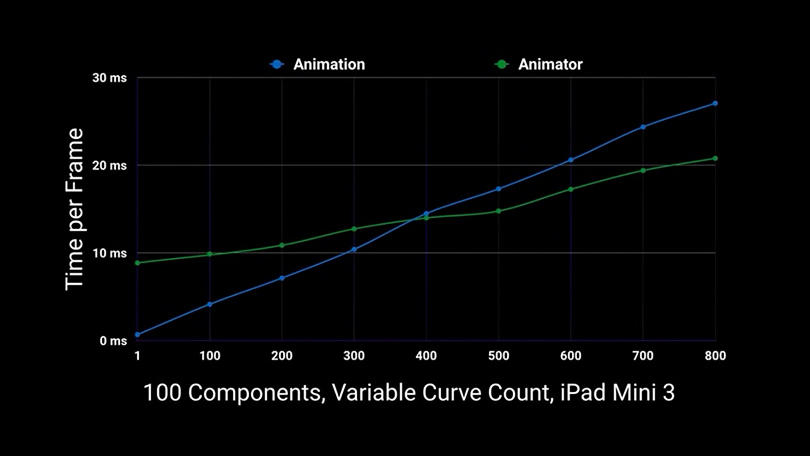
The Animator system is heavily multithreaded. Moreover, the Animator system bakes an animation clip into a "streamed blitheness clip" where multiple curves are stored in the same stream and keys for all curves are sorted by fourth dimension, designed to reduce cache misses. In general, it scales well as the number of curves in its Animation Clips increase. Therefore, it performs very well when evaluating complex animations with a large number of curves. Notwithstanding, it has a fairly high overhead cost.
The Animation system, having relatively few features, has almost no overhead. Its functioning scales less well with the number of curves in the Animation Clips existence played.
This divergence is nearly striking when the two systems are compared when playing back identical Animation Clips (encounter paradigm higher up).
When playing back Animation Clips, try to choose the system that best suits the complication of your content and the hardware on which your game will exist running. Examination your animations on your lowest-end hardware.
Generic vs humanoid rig
By default, Unity imports animated models with the Generic Rig, but developers often switch to the Humanoid Rig when animating a character. Still, using the Humanoid Rig comes at a cost.
The Humanoid Rig brings two additional features to the Animator Organisation: inverse kinematics (IK) and animation retargeting (which allows yous to reuse animations across unlike avatars).
However, even if yous don't use IK or animation retargeting, the Animator of a Humanoid-rigged graphic symbol computes IK and retargeting data for each frame. This consumes most 30–50% more CPU fourth dimension than for the Generic Rig, where these calculations are non performed.
If y'all don't need to take advantage of the specific features that the Humanoid Rig offers, you should use the Generic Rig.
Animator rebind
Object pooling is a key strategy for avoiding performance spikes during gameplay. All the same, Animators have historically been difficult to utilise with object pooling. Whenever an Animator's GameObject is enabled, it must build a list of pointers to the memory address of the backdrop the Animator is animating. This means querying the hierarchy for a component'southward specific field, which can exist expensive. This process is called an Animator Rebind, and information technology shows up in the Unity Profiler equally Animator.Rebind.
The Animator Rebind is unavoidable at least once, for any scene. It involves recursively traversing all children of the GameObject the Animator is fastened to, getting a hash of their proper noun, and comparing these to the hash of each animation curve'south target path. Therefore, having children that a hierarchy is not animating adds extra cost to the binding process. Avoiding the Animator on a GameObject that has a huge number of children it's not animating would assist Rebind performance.
Rebind for MonoBehaviour is more expensive than that for built-in classes such as Transform. The Animator component would browse the fields of the MonoBehaviour to create a sorted listing indexed by the hash of the fields' proper name. Then, for each animation curve animating a field of the MonoBehaviour, a binary search is performed on that sorted list. Therefore, it may aid reduce Rebind time if y'all keep the fields in the MonoBehaviour you are animating simple, and avoid large nested serializable structures.
After the inevitable initial Rebind, you should pool your GameObjects. Instead of enabling/disabling the whole GameObject, you can just enable/disable the Animator component to avoid rebinding.
Did you like this content?
Source: https://unity.com/how-to/best-practices-performance-optimization-unity
Belum ada Komentar untuk "How to Run Everytime Is Made Active Again Unity"
Posting Komentar