Phone Number for Fromm Electric Reading Pennsylvania
The invention of the telephone was the culmination of piece of work done by many individuals, and led to an array of lawsuits relating to the patent claims of several individuals and numerous companies.
Early evolution [edit]
The concept of the telephone dates back to the cord telephone or lover's telephone that has been known for centuries, comprising ii diaphragms continued by a taut string or wire. Sound waves are carried every bit mechanical vibrations along the string or wire from 1 diaphragm to the other. The archetype example is the tin can telephone, a children's toy made past connecting the two ends of a string to the bottoms of two metal cans, paper cups or similar items. The essential idea of this toy was that a diaphragm can collect voice sounds from the voice sounds for reproduction at a distance. One forerunner to the development of the electromagnetic telephone originated in 1833 when Carl Friedrich Gauss and Wilhelm Eduard Weber invented an electromagnetic device for the transmission of telegraphic signals at the Academy of Göttingen, in Lower Saxony, helping to create the primal basis for the technology that was later used in similar telecommunication devices. Gauss's and Weber's invention is purported to be the earth's beginning electromagnetic telegraph.[ane]
Charles Grafton Page [edit]
In 1840, American Charles Grafton Page passed an electric current through a roll of wire placed between the poles of a horseshoe magnet. He observed that connecting and disconnecting the current caused a ringing sound in the magnet. He called this effect "galvanic music".[2]
Innocenzo Manzetti [edit]
Innocenzo Manzetti considered the idea of a telephone as early as 1844, and may have made one in 1864, as an enhancement to an automaton congenital past him in 1849.
Charles Bourseul was a French telegraph engineer who proposed (only did not build) the first design of a "make-and-pause" phone in 1854. That is virtually the same fourth dimension that Meucci later claimed to have created his first attempt at the phone in Italy.
Bourseul explained: "Suppose that a human speaks virtually a movable disc sufficiently flexible to lose none of the vibrations of the vocalisation; that this disc alternately makes and breaks the currents from a battery: yous may accept at a distance another disc which will simultaneously execute the aforementioned vibrations.... It is sure that, in a more or less distant future, a speech will be transmitted by electricity. I accept made experiments in this management; they are fragile and demand fourth dimension and patience, but the approximations obtained promise a favorable result."
Antonio Meucci [edit]
An early communicating device was invented around 1854 past Antonio Meucci, who chosen it a teletrofono. In 1871 Meucci filed a caveat at the US Patent Office[ citation needed ]. His caveat describes his invention, but does non mention a diaphragm, electromagnet, conversion of audio into electrical waves, conversion of electrical waves into sound, or other essential features of an electromagnetic telephone.

The first American sit-in of Meucci'southward invention took place in Staten Island, New York in 1854[ citation needed ]. In 1861, a clarification of it was reportedly published in an Italian-language New York newspaper, although no known copy of that newspaper issue or article has survived to the nowadays solar day[ citation needed ]. Meucci claimed to take invented a paired electromagnetic transmitter and receiver, where the move of a diaphragm modulated a indicate in a whorl by moving an electromagnet, although this was not mentioned in his 1871 U.Southward. patent caveat. A further discrepancy observed was that the device described in the 1871 caveat employed but a single conduction wire, with the phone'due south transmitter-receivers being insulated from a 'basis return' path.
Meucci studied the principles of electromagnetic voice transmission for many years and was able to realise his dream of transmitting his voice through wires in 1856. He installed a telephone-similar device within his house in order to communicate with his wife who was ill at the time. Some of Meucci's notes purportedly written in 1857 draw the basic principle of electromagnetic voice manual or in other words, the telephone[three]
In the 1880s Meucci was credited with the early invention of inductive loading of telephone wires to increase long-distance signals[ citation needed ]. Unfortunately, serious burns from an accident, a lack of English, and poor business abilities resulted in Meucci's failing to develop his inventions commercially in America. Meucci demonstrated some sort of instrument in 1849 in Havana, Republic of cuba, however, this may have been a variant of a cord telephone that used wire. Meucci has been further credited with the invention of an anti-sidetone circuit. However, examination showed that his solution to sidetone was to maintain ii separate phone circuits and thus utilize twice as many manual wires[ citation needed ]. The anti-sidetone circuit later on introduced past Bell Telephone instead canceled sidetone through a feedback procedure.
An American District Telegraph (ADT) laboratory reportedly lost some of Meucci'due south working models, his wife reportedly disposed of others and Meucci, who sometimes lived on public assistance, chose not to renew his 1871 teletrofono patent caveat after 1874[ commendation needed ].
A resolution was passed by the Usa House of Representatives in 2002 that said Meucci did pioneering work on the evolution of the telephone.[four] [5] [6] [7] The resolution said that "if Meucci had been able to pay the $10 fee to maintain the caveat afterwards 1874, no patent could have been issued to Bell."
The Meucci resolution by the The states Congress was promptly followed by a Canada legislative motility by Canada'southward 37th Parliament, declaring Alexander Graham Bong equally the inventor of the telephone. Others in Canada disagreed with the Congressional resolution, some of whom provided criticisms of both its accurateness and intent.
Chronology of Meucci'south invention [edit]
A retired manager general of the Telecom Italia central telecommunications inquiry constitute (CSELT), Basilio Catania,[eight] and the Italian Society of Electrotechnics, "Federazione Italiana di Elettrotecnica", have devoted a Museum to Antonio Meucci, amalgam a chronology of his invention of the telephone and tracing the history of the two legal trials involving Meucci and Alexander Graham Bell.[9] [10] [11]
They claim that Meucci was the bodily inventor of the telephone, and base their argument on reconstructed evidence. What follows, if not otherwise stated, is a summary of their historic reconstruction.[12]
- In 1834 Meucci constructed a kind of audio-visual telephone as a way to communicate between the stage and control room at the theatre "Teatro della Pergola" in Florence. This telephone is constructed on the model of pipe-telephones on ships and is still working.[13]
- In 1848 Meucci developed a popular method of using electric shocks to treat rheumatism. He used to give his patients two conductors linked to 60 Bunsen batteries and ending with a cork. He also kept 2 conductors linked to the same Bunsen batteries. He used to sit in his laboratory, while the Bunsen batteries were placed in a second room and his patients in a third room. In 1849 while providing a treatment to a patient with a 114V electric discharge, in his laboratory Meucci heard his patient's scream through the piece of copper wire that was between them, from the conductors he was keeping near his ear. His intuition was that the "natural language" of copper wire was vibrating just like a leaf of an electroscope; which means that there was an electrostatic upshot. In order to continue the experiment without hurting his patient, Meucci covered the copper wire with a piece of newspaper. Through this device he heard inarticulated human being voice. He called this device "telegrafo parlante" (litt. "talking telegraph").[14]
- On the basis of this prototype, Meucci worked on more than xxx kinds of sound transmitting devices inspired past the telegraph model as did other pioneers of the telephone, such as Charles Bourseul, Philipp Reis, Innocenzo Manzetti and others. Meucci later claimed that he did not call back about transmitting vox by using the principle of the telegraph "make-and-break" method, but he looked for a "continuous" solution that did not interrupt the electric electric current.
- Meucci later claimed that he synthetic the offset electromagnetic telephone, made of an electromagnet with a nucleus in the shape of a horseshoe bat, a diaphragm of animal peel, stiffened with potassium dichromate and keeping a metallic disk stuck in the middle. The musical instrument was hosted in a cylindrical carton box.[15] He said he constructed this every bit a way to connect his second-floor chamber to his basement laboratory, and thus communicate with his wife who was an invalid.
- Meucci separated the ii directions of transmission in society to eliminate the so-called "local consequence", adopting what we would phone call today a 4-wire-circuit. He constructed a simple calling system with a telegraphic manipulator which brusque-circuited the instrument of the calling person, producing in the instrument of the called person a succession of impulses (clicks), much more than intense than those of normal chat. Every bit he was aware that his device required a bigger band than a telegraph, he found some means to avert the then-called "peel consequence" through superficial treatment of the conductor or past acting on the material (copper instead of iron). He successfully used an insulated copper plait, thus anticipating the litz wire used by Nikola Tesla in RF coils.
- In 1864 Meucci afterward claimed that he realized his "all-time device", using an iron diaphragm with optimized thickness and tightly clamped along its rim. The instrument was housed in a shaving-soap box, whose cover clamped the diaphragm.
- In August 1870, Meucci after claimed that he obtained transmission of articulate human vocalisation at a mile distance by using as a conductor a copper plait insulated by cotton. He called his device "teletrofono". Drawings and notes by Antonio Meucci dated September 27, 1870, evidence coils of wire on long-altitude phone lines.[16] The painting made by Nestore Corradi information technology:Nestore Corradi in 1858 mentions the sentence "Electric electric current from the inductor pipage"
The above information was published in the Scientific American Supplement No. 520 of Dec 19, 1885,[17] based on reconstructions produced in 1885, for which in that location was no contemporary pre-1875 evidence. Meucci's 1871 caveat did not mention any of the telephone features afterwards credited to him by his lawyer, and which were published in that Scientific American Supplement, a major reason for the loss of the 'Bell v. World and Meucci' patent infringement court example, which was decided against Globe and Meucci.[18] See Antonio Meucci – Patent caveat, for the full printed text of his 1871 teletrofono patent caveat.
Johann Philipp Reis [edit]

A stamp defended to Johann Philipp Reis
The Reis telephone was developed from 1857 onwards. Allegedly, the transmitter was difficult to operate, since the relative position of the needle and the contact were critical to the device's operation. Thus, it can exist chosen a "telephone", since it did transmit vocalization sounds electrically over distance, but was hardly a commercially applied telephone in the modern sense.
Thomas Edison tested the Reis equipment and constitute that "single words, uttered as in reading, speaking and the like, were perceptible indistinctly, notwithstanding hither also the inflections of the vocalization, the modulations of interrogation, wonder, command, etc., attained distinct expression."[19]
In 1874, the Reis device was tested past the British company Standard Telephones and Cables (STC). The results too confirmed it could transmit and receive speech with practiced quality (fidelity), merely relatively low intensity.[ citation needed ]
Cyrille Duquet [edit]
Cyrille Duquet invents the handset.[20]
Duquet obtained a patent on i Feb. 1878 for a number of modifications "giving more facility for the transmission of sound and adding to its acoustic properties," and in item for the design of a new apparatus combining the speaker and receiver in a single unit.[20]
Electro-magnetic transmitters and receivers [edit]
Elisha Greyness [edit]
Elisha Greyness, of Highland Park, Illinois, also devised a tone telegraph of this kind about the same time as La Cour. In Gray'southward tone telegraph, several vibrating steel reeds tuned to different frequencies interrupted the current, which at the other end of the line passed through electromagnets and vibrated matching tuned steel reeds almost the electromagnet poles. Gray's "harmonic telegraph", with vibrating reeds, was used by the Western Union Telegraph Visitor. Since more than ane set of vibration frequencies – that is to say, more one musical tone – tin be sent over the same wire simultaneously, the harmonic telegraph can be utilized every bit a 'multiplex' or many-ply telegraph, carrying several messages through the aforementioned wire at the aforementioned time. Each message can either be read by an operator past the sound, or from dissimilar tones read by different operators, or a permanent record tin exist made by the marks drawn on a ribbon of traveling paper by a Morse recorder. On July 27, 1875, Gray was granted U.S. patent 166,096 for "Electric Telegraph for Transmitting Musical Tones" (the harmonic).
On February 14, 1876, at the U.s. Patent Office, Gray's lawyer filed a patent caveat for a telephone on the very aforementioned day that Bell's lawyer filed Bong's patent application for a telephone. The water transmitter described in Gray's caveat was strikingly similar to the experimental telephone transmitter tested past Bell on March 10, 1876, a fact which raised questions about whether Bell (who knew of Gray) was inspired by Gray's design or vice versa. Although Bell did not use Gray'south h2o transmitter in afterwards telephones, bear witness suggests that Bell's lawyers may accept obtained an unfair advantage over Greyness.[21]
Alexander Graham Bell [edit]

Bell's March ten, 1876, laboratory notebook entry describing his first successful experiment with the telephone
Alexander Graham Bell had pioneered a organization chosen visible speech communication, developed by his male parent, to teach deaf children. In 1872 Bell founded a school in Boston to railroad train teachers of the deaf. The school subsequently became office of Boston Academy, where Bell was appointed professor of song physiology in 1873.
As Professor of Song Physiology at Boston University, Bell was engaged in training teachers in the art of instructing the deaf how to speak and experimented with the Leon Scott phonautograph in recording the vibrations of speech. This apparatus consists essentially of a thin membrane vibrated by the vox and carrying a light-weight stylus, which traces an undulatory line on a plate of smoked glass. The line is a graphic representation of the vibrations of the membrane and the waves of audio in the air.[22]
This background prepared Bell for work with spoken sound waves and electricity. He began his experiments in 1873–1874 with a harmonic telegraph, following the examples of Bourseul, Reis, and Gray. Bell's designs employed diverse on-off-on-off make-interruption current-interrupters driven by vibrating steel reeds which sent interrupted current to a afar receiver electro-magnet that caused a second steel reed or tuning fork to vibrate.[23]
During a June 2, 1875, experiment by Bell and his banana Thomas Watson, a receiver reed failed to reply to the intermittent current supplied by an electric battery. Bong told Watson, who was at the other end of the line, to pluck the reed, thinking it had stuck to the pole of the magnet. Watson complied, and to his astonishment Bell heard a reed at his terminate of the line vibrate and emit the same timbre of a plucked reed, although there were no interrupted on-off-on-off currents from a transmitter to brand information technology vibrate.[24] A few more experiments presently showed that his receiver reed had been set in vibration by the magneto-electric currents induced in the line past the motion of the distant receiver reed in the neighborhood of its magnet. The battery current was not causing the vibration but was needed only to supply the magnetic field in which the reeds vibrated. Moreover, when Bell heard the rich overtones of the plucked reed, information technology occurred to him that since the circuit was never broken, all the complex vibrations of speech might be converted into undulating (modulated) currents, which in turn would reproduce the complex timbre, amplitude, and frequencies of speech at a distance.
After Bell and Watson discovered on June ii, 1875, that movements of the reed alone in a magnetic field could reproduce the frequencies and timbre of spoken sound waves, Bell reasoned by analogy with the mechanical phonautograph that a skin diaphragm would reproduce sounds like the human being ear when connected to a steel or iron reed or hinged armature. On July 1, 1875, he instructed Watson to build a receiver consisting of a stretched diaphragm or drum of goldbeater's skin with an armature of magnetized fe attached to its middle, and free to vibrate in forepart of the pole of an electromagnet in circuit with the line. A second membrane-device was built for employ as a transmitter.[25] This was the "gallows" phone. A few days subsequently they were tried together, i at each end of the line, which ran from a room in the inventor's house, located at v Exeter Identify in Boston, to the cellar underneath.[26] Bell, in the work room, held one instrument in his hands, while Watson in the cellar listened at the other. Bell spoke into his musical instrument, "Do you understand what I say?" and Watson answered "Yep". Nevertheless, the voice sounds were non distinct and the armature tended to stick to the electromagnet pole and tear the membrane.
In a March 10, 1876, test, between two rooms in a single building in Boston[27] showed that the telephone worked, just then far, merely at a short range.[28] [29]
In 1876, Bong became the kickoff to obtain a patent for an "apparatus for transmitting vocal or other sounds telegraphically", after experimenting with many primitive sound transmitters and receivers. Considering of illness and other commitments, Bell made niggling or no telephone improvements or experiments for eight months until after his U.S. patent 174,465 was published.,[25] but within a twelvemonth the first phone commutation was built in Connecticut and the Bell Telephone Visitor was created in 1877, with Bell the owner of a tertiary of the shares, apace making him a wealthy homo.

The master telephone patent, 174465, granted to Bong, March vii, 1876
In 1880, Bell was awarded the French Volta Prize for his invention and with the money, founded the Volta Laboratory in Washington,[ which? ] where he continued experiments in communication, in medical enquiry, and in techniques for didactics spoken communication to the deaf, working with Helen Keller amidst others. In 1885 he acquired land in Nova Scotia and established a summer home there where he continued experiments, particularly in the field of aviation.
Bong himself claimed that the telephone was invented in Canada but fabricated in the U.s.a..[thirty]
Bell's success [edit]
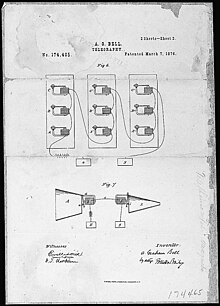
Alexander Graham Bell's phone patent[31] drawing, March seven, 1876

Bell's Prototype Telephone Centennial Issue of 1976
The first successful bi-directional transmission of clear speech past Bong and Watson was made on March x, 1876, when Bell spoke into the device, "Mr. Watson, come up here, I desire to see yous." and Watson complied with the request. Bong tested Greyness's liquid transmitter design[32] in this experiment, but merely after Bong's patent was granted and merely equally a proof of concept scientific experiment[33] to prove to his own satisfaction that intelligible "articulate speech" (Bell's words) could be electrically transmitted.[34] Because a liquid transmitter was not practical for commercial products, Bell focused on improving the electromagnetic telephone afterwards March 1876 and never used Gray'due south liquid transmitter in public demonstrations or commercial apply.[35]
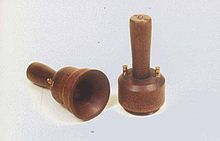
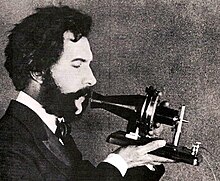
Bell'due south phone transmitter (microphone) consisted of a double electromagnet, in front of which a membrane, stretched on a ring, carried an oblong piece of soft fe cemented to its middle. A funnel-shaped mouthpiece directed the voice sounds upon the membrane, and as it vibrated, the soft atomic number 26 "armature" induced corresponding currents in the coils of the electromagnet. These currents, after traversing the wire, passed through the receiver which consisted of an electromagnet in a tubular metal tin can having one end partially closed past a thin circular disc of soft iron. When the undulatory electric current passed through the coil of this electromagnet, the disc vibrated, thereby creating audio waves in the air.
This primitive telephone was chop-chop improved. The double electromagnet was replaced by a single permanently magnetized bar magnet having a modest curl or bobbin of fine wire surrounding one pole, in front of which a thin disc of iron was fixed in a round mouthpiece. The disc served equally a combined diaphragm and armature. On speaking into the mouthpiece, the iron diaphragm vibrated with the phonation in the magnetic field of the bar-magnet pole, and thereby caused undulatory currents in the scroll. These currents, after traveling through the wire to the distant receiver, were received in an identical appliance. This design was patented by Bell on January 30, 1877. The sounds were weak and could only be heard when the ear was close to the earphone/mouthpiece, but they were distinct.
In the third of his tests in Southern Ontario, on August 10, 1876, Bell made a telephone call via the telegraph line from the family homestead in Brantford, Ontario, to his assistant located in Paris, Ontario, some xiii kilometers away. This test was claimed by many sources equally the world's first long-distance call.[36] [37] The final test certainly proved that the telephone could work over long distances.
Public demonstrations [edit]
Early public demonstrations of Bell's phone [edit]
Bell exhibited a working telephone at the Centennial Exhibition in Philadelphia in June 1876, where it attracted the attending of Brazilian emperor Pedro Two plus the physicist and engineer Sir William Thomson (who would later be ennobled every bit the 1st Baron Kelvin). In August 1876 at a meeting of the British Association for the Advancement of Science, Thomson revealed the telephone to the European public. In describing his visit to the Philadelphia Exhibition, Thomson said, "I heard [through the phone] passages taken at random from the New York newspapers: 'S.South. Cox Has Arrived' (I failed to brand out the Due south.S. Cox); 'The City of New York', 'Senator Morton', 'The Senate Has Resolved To Print A Thousand Actress Copies', 'The Americans In London Have Resolved To Celebrate The Coming Fourth Of July!' All this my own ears heard spoken to me with unmistakable distinctness by the then circular disc armature of just such another little electro-magnet as this I hold in my hand."
Three great tests of the telephone [edit]
Simply a few months after receiving U.S. Patent No. 174465 at the beginning of March 1876, Bell conducted three important tests of his new invention and the telephone applied science after returning to his parents' dwelling house at Melville Firm (now the Bell Homestead National Celebrated Site) for the summer.
On March ten, 1876 Bong had used "the instrument" in Boston to telephone call Thomas Watson who was in another room but out of earshot. He said, "Mr. Watson, come up here – I desire to see you" and Watson before long appeared at his side.[38]
In the first test call at a longer distance in Southern Ontario, on August 3, 1876, Alexander Graham's uncle, Professor David Charles Bong, spoke to him from the Brantford telegraph office, reciting lines from Shakespeare's Village ("To exist or not to be....").[39] [40] The young inventor, positioned at the A. Wallis Ellis store in the neighboring community of Mount Pleasant,[39] [41] received and may possibly have transferred his uncle's voice onto a phonautogram, a cartoon made on a pen-similar recording device that could produce the shapes of audio waves as waveforms onto smoked glass or other media by tracing their vibrations.
The next twenty-four hours on Baronial 4 another phone call was fabricated betwixt Brantford'south telegraph function and Melville House, where a large dinner party exchanged "....speech, recitations, songs and instrumental music".[39] To bring phone signals to Melville House, Alexander Graham audaciously "bought up" and "cleaned upward" the complete supply of stovepipe wire in Brantford.[42] [43] With the help of two of his parents' neighbours,[44] he tacked the stovepipe wire some 400 metres (a quarter mile) along the pinnacle of debate posts from his parents' dwelling house to a junction point on the telegraph line to the neighbouring community of Mountain Pleasant, which joined it to the Rule Telegraph role in Brantford, Ontario.[45] [46]
The third and almost important test was the world's beginning truthful long-distance telephone call, placed between Brantford and Paris, Ontario on August x, 1876.[47] [48] For that long-distance telephone call Alexander Graham Bell ready a telephone using telegraph lines at Robert White'south Boot and Shoe Store at 90 Grand River Street Northward in Paris via its Dominion Telegraph Co. function on Colborne Street. The normal telegraph line between Paris and Brantford was not quite thirteen km (8 miles) long, but the connection was extended a further 93 km (58 miles) to Toronto to allow the employ of a bombardment in its telegraph role.[39] [49] Granted, this was a one-style long-distance call. The first two-way (reciprocal) conversation over a line occurred between Cambridge and Boston (roughly 2.5 miles) on October 9, 1876.[50] During that conversation, Bell was on Kilby Street in Boston and Watson was at the offices of the Walworth Manufacturing Company.[51]
Scientific American described the iii exam calls in their September ix, 1876, article, "The Human being Voice Transmitted by Telegraph".[49] Historian Thomas Costain referred to the calls every bit "the three great tests of the telephone".[52] I Bong Homestead reviewer wrote of them, "No one involved in these early calls could possibly have understood the futurity touch on of these advice firsts".[53]
Subsequently public demonstrations [edit]
A later telephone design was publicly exhibited on May 4, 1877, at a lecture given past Professor Bell in the Boston Music Hall. According to a report quoted by John Munro in Heroes of the Telegraph:
Going to the small phone box with its slender wire attachments, Mr. Bong coolly asked, as though addressing someone in an adjoining room, "Mr. Watson, are you gear up!" Mr. Watson, five miles abroad in Somerville, promptly answered in the affirmative, and shortly was heard a phonation singing "America". [...] Going to another instrument, connected by wire with Providence, forty-three miles distant, Mr. Bell listened a moment, and said, "Signor Brignolli, who is assisting at a concert in Providence Music Hall, volition at present sing for the states." In a moment the cadence of the tenor's voice rose and fell, the sound being faint, sometimes lost, and and then once again aural. Later, a cornet solo played in Somerville was very distinctly heard. Still later on, a three-part vocal came over the wire from Somerville, and Mr. Bell told his audience "I will switch off the vocal from 1 role of the room to another so that all can hear." At a subsequent lecture in Salem, Massachusetts, advice was established with Boston, 18 miles distant, and Mr. Watson at the latter place sang "Auld Lang Syne", the National Canticle, and "Hail Columbia", while the audience at Salem joined in the chorus. [54]
On January 14, 1878, at Osborne Firm, on the Isle of Wight, Bell demonstrated the device to Queen Victoria,[55] placing calls to Cowes, Southampton and London. These were the beginning publicly witnessed long-distance telephone calls in the UK. The queen considered the process to be "quite extraordinary" although the sound was "quite faint".[56] She later asked to buy the equipment that was used, just Bong offered to make a model specifically for her.[57] [58]
Summary of Bell's achievements [edit]
Bell did for the telephone what Henry Ford did for the machine. Although not the commencement to experiment with telephonic devices, Bell and the companies founded in his proper noun were the beginning to develop commercially practical telephones around which a successful business could be congenital and grow. Bong adopted carbon transmitters similar to Edison's transmitters and adapted telephone exchanges and switching plug boards developed for telegraphy. Watson and other Bell engineers invented numerous other improvements to telephony. Bell succeeded where others failed to assemble a commercially viable phone system. It can be argued that Bell invented the telephone manufacture. Bell'southward first intelligible vox transmission over an electric wire was named an IEEE Milestone.[59]
Variable resistance transmitters [edit]
Water microphone – Elisha Gray [edit]
Elisha Gray recognized the lack of fidelity of the make-break transmitter of Reis and Bourseul and reasoned by analogy with the lover'south telegraph, that if the current could be fabricated to more than closely model the movements of the diaphragm, rather than just opening and closing the circuit, greater allegiance might exist achieved. Gray filed a patent caveat with the U.s. patent office on February 14, 1876, for a liquid microphone. The device used a metal needle or rod that was placed – just barely – into a liquid usher, such every bit a water/acid mixture. In response to the diaphragm'due south vibrations, the needle dipped more or less into the liquid, varying the electrical resistance and thus the electric current passing through the device and on to the receiver. Gray did not convert his caveat into a patent awarding until later on the caveat had expired and hence left the field open to Bell.
When Grayness applied for a patent for the variable resistance phone transmitter, the Patent Office determined "while Gray was undoubtedly the kickoff to conceive of and disclose the (variable resistance) invention, as in his caveat of fourteen February 1876, his failure to have any activity amounting to completion until others had demonstrated the utility of the invention deprives him of the right to accept it considered."[60]
Carbon microphone – Thomas Edison, Edward Hughes, Emile Berliner [edit]
The carbon microphone was independently developed around 1878 by David Edward Hughes in England and Emile Berliner and Thomas Edison in the U.s.a.. Although Edison was awarded the first patent in mid-1877, Hughes had demonstrated his working device in forepart of many witnesses some years before, and most historians credit him with its invention.
Thomas Alva Edison took the side by side pace in improving the telephone with his invention in 1878 of the carbon grain "transmitter" (microphone) that provided a strong voice point on the transmitting circuit that fabricated long-distance calls practical. Edison discovered that carbon grains, squeezed between 2 metallic plates, had a variable electrical resistance that was related to the force per unit area. Thus, the grains could vary their resistance as the plates moved in response to sound waves, and reproduce sound with expert fidelity, without the weak signals associated with electromagnetic transmitters.
The carbon microphone was further improved by Emile Berliner, Francis Blake, David Due east. Hughes, Henry Hunnings, and Anthony White. The carbon microphone remained standard in telephony until the 1980s, and is however being produced.
Improvements to the early on telephone [edit]
Additional inventions such equally the telephone call bong, central phone commutation, common battery, band tone, amplification, torso lines, and wireless phones – at commencement cordless and so fully mobile – fabricated the phone the useful and widespread apparatus as it is now.
Phone exchanges [edit]
The telephone exchange was an thought of the Hungarian engineer Tivadar Puskás (1844–1893) in 1876, while he was working for Thomas Edison on a telegraph exchange.[61] [62] [63] [64] Puskás was working on his idea for an electrical telegraph exchange when Alexander Graham Bong received the first patent for the telephone. This caused Puskás to take a fresh expect at his own work and he refocused on perfecting a pattern for a phone exchange. He and then got in touch with the U.S. inventor Thomas Edison who liked the design. According to Edison, "Tivadar Puskas was the first person to propose the idea of a phone exchange".[65]
Controversies [edit]
Bell has been widely recognized every bit the "inventor" of the telephone outside of Italian republic, where Meucci was championed every bit its inventor. In the Usa, there are numerous reflections of Bell as a North American icon for inventing the phone, and the thing was for a long time non-controversial. In June 2002, even so, the The states Firm of Representatives passed a symbolic bill recognizing the contributions of Antonio Meucci "in the invention of the telephone" (not "for the invention of the telephone"), throwing the matter into some controversy. Ten days later the Canadian parliament countered with a symbolic move attributing the invention of the telephone to Bell.
Champions of Meucci, Manzetti, and Gray have each offered fairly precise tales of a contrivance whereby Bell actively stole the invention of the telephone from their specific inventor. In the 2002 congressional resolution, it was inaccurately noted that Bell worked in a laboratory in which Meucci'southward materials had been stored, and claimed that Bong must thus have had access to those materials. Manzetti claimed that Bell visited him and examined his device in 1865. In 1886 it was publicly alleged by Zenas Wilber, a patent examiner, that Bong paid him one hundred dollars, when he allowed Bell to look at Gray's confidential patent filing.[66]
I of the valuable claims in Bell's 1876 U.S. Patent 174,465 was claim four, a method of producing variable electric current in a excursion by varying the resistance in the circuit. That feature was non shown in any of Bell'south patent drawings, just was shown in Elisha Gray'southward drawings in his caveat filed the same twenty-four hour period, February 14, 1876. A description of the variable resistance characteristic, consisting of seven sentences, was inserted into Bell'south application. That it was inserted is not disputed. But when it was inserted is a controversial issue. Bell testified that he wrote the sentences containing the variable resistance feature before January 18, 1876, "almost at the last moment" before sending his draft application to his lawyers. A volume by Evenson[67] argues that the seven sentences and merits four were inserted, without Bong'southward knowledge, just before Bell's application was paw carried to the Patent Office by ane of Bell's lawyers on February fourteen, 1876.
Contrary to the popular story, Grey's caveat was taken to the US Patent Function a few hours before Bell'southward application. Grayness's caveat was taken to the Patent Office in the morning of February xiv, 1876, soon subsequently the Patent Role opened and remained near the bottom of the in-handbasket until that afternoon. Bell'southward application was filed shortly before noon on February 14 past Bell's lawyer who requested that the filing fee be entered immediately onto the greenbacks receipts blotter and Bell's application was taken to the Examiner immediately. Tardily in the afternoon, Gray's caveat was entered on the greenbacks blotter and was not taken to the Examiner until the following twenty-four hours. The fact that Bell'south filing fee was recorded earlier than Gray'southward led to the myth that Bell had arrived at the Patent Office earlier.[68] Bell was in Boston on Feb 14 and did not know this happened until later. Gray later on abased his caveat and did non contest Bell'due south priority. That opened the door to Bell existence granted US patent 174465 for the phone on March 7, 1876.
Memorial to the invention [edit]
In 1906 the citizens of the Metropolis of Brantford, Ontario, Canada and its surrounding area formed the Bell Memorial Association to commemorate the invention of the telephone by Alexander Graham Bell in July 1874 at his parents' domicile, Melville Business firm, almost Brantford.[69] [lxx] Walter Allward'southward blueprint was the unanimous choice from among 10 submitted models, winning the contest. The memorial was originally to be completed by 1912 but Allward did not finish it until five years later. The Governor General of Canada, Victor Cavendish, 9th Knuckles of Devonshire, ceremoniously unveiled the memorial on October 24, 1917.[69] [seventy]
Allward designed the monument to symbolize the telephone's power to overcome distances.[seventy] A series of steps atomic number 82 to the principal section where the floating allegorical figure of Inspiration appears over a reclining male figure representing Man, discovering his power to transmit audio through infinite, and also pointing to iii floating figures, the messengers of Noesis, Joy, and Sorrow positioned at the other end of the tableau. Additionally, there are two female figures mounted on granite pedestals representing Humanity positioned to the left and correct of the memorial, 1 sending and the other receiving a message.[69]
The Bong Telephone Memorial's grandeur has been described as the finest example of Allward's early piece of work, propelling the sculptor to fame. The memorial itself has been used equally a fundamental fixture for many civic events and remains an important part of Brantford's history, helping the city style itself equally 'The Telephone City'.

The Bell Telephone Memorial, commemorating the invention of the phone by Alexander Graham Bell. The monument, paid by public subscription and sculpted by W.Due south. Allward, was dedicated by the Governor General of Canada, Victor Cavendish, 9th Knuckles of Devonshire with Dr. Bell in The Telephone City's Alexander Graham Bell Gardens in 1917. Included on the master tableau are figures representing Man, discovering his ability to transmit sound through infinite, Inspiration whispering to Human, his power to transmit sound through space, as well every bit Knowledge, Joy, Sorrow. (Courtesy: Brantford Heritage Inventory, City of Brantford, Ontario, Canada)
See also [edit]
- History of the telephone
- The Telephone Cases, U.S. patent dispute and infringement court cases
- Timeline of the telephone
References [edit]
- ^ Erster elektromagnetischer Telegraph der Welt über den Dächern von Göttingen (Get-go electromagnetic telegraph in the earth over the roofs of Göttingen), Georg-Baronial-Universität Göttingen website. Retrieved January 22, 2013. (in German language)
- ^ [i] [ permanent dead link ]
- ^ "Antonio Meucci - Electromagnetic Telephone | Engineering Trends". www.primidi.com . Retrieved July 12, 2021.
- ^ "House Resolution 269". Archived from the original on December 29, 2015. Retrieved September 21, 2017.
- ^ Wheen, Andrew. Dot-Nuance to Dot.com: How Modern Telecommunications Evolved from the Telegraph to the Internet. Springer, 2010. p. 45. Web. 23 Sep. 2011.
- ^ Cleveland, Cutler (Pb Author) ; Saundry, Peter (Topic Editor). Meucci, Antonio. Encyclopedia of Earth, 2006. Web. 22 Jul. 2012.
- ^ (in Italian) Caretto, Ennio. Gli The states ammettono: Meucci è l' inventore del telefono. Corriere della Sera. Web. 21 Jul. 2012.
- ^ Basilio Catania Homepage
- ^ Fifty'invenzione del telefono da parte di Meucci eastward la sua sventurata e ingiusta conclusione
- ^ Meucci, ChezBasilio.org website
- ^ aei.it website
- ^ Basilio Catania'due south reconstruction, in English
- ^ Picture of the acoustic telephone, folio maintained by the Italian Guild of Electrotechnics
- ^ Meucci'southward original drawings. Page maintained by the Italian Society of Electrotechnics
- ^ Meucci's original drawings. Page maintained by the Italian Society of Electrotechnics Archived July 28, 2010, at the Wayback Machine
- ^ Affidavit of lawyer Michael Lemmi
- ^ Scientific American Supplement No. 520, December 19, 1885
- ^ Meucci'southward 1871 patent caveat, pages sixteen-xviii
- ^ Coe, page 23
- ^ a b DUQUET, Cyrille
- ^ Inventors Digest, July/August 1998, pp. 26–28
- ^ Robert Bruce (1990), pages 102–103, 110–113, 120–121
- ^ Robert Bruce (1990), pages 104–109
- ^ Robert Bruce (1990), pages 146–148
- ^ a b Robert Bruce (1990), page 149
- ^ Puleo, Stephen (2011). A City Then Grand: The Rising of an American Metropolis, Boston 1850-1900. Buoy Press. p. 195. ISBN978-0807001493.
- ^ Evenson, A Edward (November 10, 2000). The Telephone Patent Conspiracy of 1876: The Elisha Grey-Alexander Bell Controversy and Its Many Players. McFarland. p. 99. ISBN0786408839.
- ^ American Treasures of the Library of Congress ... Bong - Lab notebook
- ^ Puleo, Stephen (2011). A Metropolis Then M: The Ascent of an American Urban center, Boston 1850-1900. Buoy Press. p. 195. ISBN978-0807001493.
- ^ https://www.collectionscanada.gc.ca/innovations/023020-3020-eastward.html [ dead link ]
- ^ US 174465 Alexander Graham Bell: "Improvement in Telegraphy" filed on February 14, 1876, granted on March vii, 1876.
- ^ Shulman, pages 36-37. Bell'southward lab notes dated March 9, 1876 show a drawing of a person speaking confront downwards into a liquid transmitter very similar to the liquid transmitter depicted as Fig. 3 in Greyness'south caveat.
- ^ Evenson, folio 99.
- ^ Evenson, page 98.
- ^ Evenson, page 100.
- ^ "Alexander Graham Bell 1847-1922 Inventor of the Bell System". Telecommunications Canada. Retrieved Jan 14, 2020.
- ^ "Invention of the Telephone National Celebrated Event". Parks Canada. Retrieved January fourteen, 2020.
Bell made public demonstrations of his at present patented invention, culminating in the earth's beginning long distance call, to Paris, 13 kilometres away, on 10 August
- ^ Evenson, A Edward (November 10, 2000). The Telephone Patent Conspiracy of 1876: The Elisha Grayness-Alexander Bong Controversy and Its Many Players. McFarland. p. 99. ISBN0786408839.
- ^ a b c d "First Phone Office", CWB, November 17, 1971, pp. 4–5.
- ^ "You lot Can Tour The Business firm in Brantford Where Bell Worked on His Phone", Toronto Daily Star, Dec 26, 1970.
- ^ MacLeod, Elizabeth. Alexander Graham Bell: An Inventive Life, Toronto, Ontario, Canada: Kids Can Printing, 1999, ISBN 1-55074-456-9, p. 14.
- ^ "Bong Emphatic in Declaring That Telephone Was Invented Here", Brantford Expositor, August 10, 1936, p. 15.
- ^ "Use of Stove Pipage Wire Is Related at Banquet: Graham Tells Of Some Early Experiments", Brantford Expositor, August 10, 1936, p. 17.
- ^ Patten, William; Bell, Alexander Melville. Pioneering The Phone In Canada, Montreal: Herald Press, 1926. N.B.: Patten's full name was William Patten, not Gulielmus Patten every bit credited elsewhere.
- ^ Patten & Bell, 1926, p. 15–16, nineteen.
- ^ "The Bell Homestead", Montreal, Canada: Telephone Historical Collection, The Bell Phone Co. of Canada, December 29, 1954, pp. 1–ii.
- ^ Harrington, Stephanie. "Bell Homestead: Home Offers In-depth Look At Inventor", Brantford and Brant County Community Guide, 2002–2003", Brantford Expositor, 2002.
- ^ Korfmann, Margret. "Homestead's History Highlighted", Brantford Expositor, Feb 22, 1985.
- ^ a b "A .G. Bong's Brantford House Is Museum of the Telephone", Toronto Star, April 25, 1987, p. H-23.
- ^ Pop Mechanics Aug 1912. New York: Popular Mechanics. Baronial 1912. p. 186.
- ^ First Phone Call 685 Chief Street
- ^ "First Long Distance Telephone Call Recalled", Brantford Expositor, August xi, 1976.
- ^ Butorac, Yvonne (June 29, 1995). "Bong's Brantford Homestead Celebrates Phone Invention". Toronto Star. p. G10. ProQuest document ID 437257031.
- ^ Munro, John. Heroes of the Telegraph, London: The Religious tract society, 1891. Notation: public domain text
- ^ "140 YEARS SINCE Get-go Telephone Phone call TO QUEEN VICTORIA ON THE Isle OF WIGHT". Isle Echo. January 14, 2018. Retrieved January 14, 2020.
He made the UK's first publicly-witnessed long altitude calls, calling Cowes, Southampton and London. Queen Victoria liked the telephone so much she wanted to purchase it.
- ^ "Alexander Graham Bell demonstrates the newly invented telephone". The Telegraph. Jan 13, 2017. Retrieved January xiv, 2020.
one of the Queen's staff wrote to Professor Bell to inform him "how much gratified and surprised the Queen was at the exhibition of the Phone"
- ^ "pdf, Letter from Alexander Graham Bell to Sir Thomas Biddulph, Feb 1, 1878". Library of Congress. Retrieved January xiv, 2020.
The instruments at nowadays in Osborne are merely those supplied for ordinary commercial purposes, and information technology will afford me much pleasance to be permitted to offer to the Queen a ready of Telephones to be fabricated expressly for her Majesty'southward utilize.
- ^ Ross, Stewart (2001). Alexander Graham Bong. (Scientists who Made History). New York: Raintree Steck-Vaughn. pp. 21–22. ISBN978-0-7398-4415-1.
- ^ "Milestones:First Intelligible Phonation Manual over Electrical Wire, 1876". IEEE Global History Network. IEEE. Retrieved July 27, 2011.
- ^ Burton Baker, pages 90–91
- ^ Puskás Tivadar (1844–1893) (brusque biography), Hungarian History website. Retrieved from Archive.org, February 2013.
- ^ "Puskás Tivadar (1844–1893)". Mszh.hu. Archived from the original on October 8, 2010. Retrieved July one, 2012.
- ^ "Puskás, Tivadar". Omikk.bme.hu. Retrieved July ane, 2012.
- ^ "Puskás Tivadar". Hunreal.com. Archived from the original on March 16, 2012. Retrieved July 1, 2012.
- ^ Frank Lewis Dyer and Thomas Commerford Martin. Edison, His Life And Inventions, Harper & Brothers, 1910, p. 71. Retrieved from Gutenberg.org.
- ^ The Washington Mail, May 22, 1886
- ^ Evenson, pp 64–69, 86–87, 110, 194–196
- ^ Evenson, pages 68–69
- ^ a b c Whitaker, A.J. Bell Telephone Memorial, City of Brantford/Hurley Printing, Brantford, Ontario, 1944.
- ^ a b c Osborne, Harold Due south. (1943) Biographical Memoir of Alexander Graham Bell, National Academy of Sciences: Biographical Memoirs, Vol. XXIII, 1847–1922. Presented to the Academy at its 1943 annual meeting.
Further reading [edit]
- Bakery, Burton H. (2000), The Gray Matter: The Forgotten Story of the Phone, St. Joseph, MI, 2000. ISBN 0-615-11329-Ten
- Bong, Alexander Graham. (1911), Speech by Alexander Graham Bong, November 2, 1911: Historical address delivered by Alexander Graham Bell, November two, 1911, at the outset meeting of the Phone Pioneers' Association, Beinn Bhreagh Recorder, November 1911, pp. 15–nineteen;
- Bethune, Brian, (2008) Did Bong Steal the Idea for the Phone? (Book Review), Maclean'southward Magazine, February four, 2008;
- Bourseul, Charles, Transmission électrique de la parole, 50'Illustration (Paris), August 26, 1854 (in French)
- Bruce, Robert V. (1990), Bell: Alexander Bell and the Conquest of Solitude, Cornell University Press, 1990. ISBN 0-8014-9691-8
- Coe, Lewis (1995), The Telephone and Its Several Inventors: A History, McFarland, Due north Carolina, 1995. ISBN 0-7864-0138-9
- Evenson, A. Edward (2000), The Telephone Patent Conspiracy of 1876: The Elisha Gray – Alexander Bong Controversy, McFarland, Due north Carolina, 2000. ISBN 0-7864-0883-9
- Gray, Charlotte, (2006) "Reluctant Genius: The Passionate Life and Inventive Mind of Alexander Graham Bell", HarperCollins, Toronto, 2006, ISBN 0-00-200676-6, ISBN 978-0-00-200676-7 IBO: 621.385092;
- Josephson, Matthew (1992), Edison: A Biography, Wiley, ISBN 0-471-54806-5
- Shulman, Seth, (2007) Phone Gambit: Chasing Alexander Graham Bell'southward Secret, Westward.W. Norton & Comp.; 1st Edition, December 25, 2007, ISBN 978-0-393-06206-ix
- Thompson, Sylvanus P. (1883), Philipp Reis, Inventor of the Telephone, London: E. & F. North. Spon, 1883.
External links [edit]
- Heroes of the Telegraph by John Munro at Project Gutenberg
- American Treasures of the Library of Congress, Alexander Graham Bell – Lab notebook I, pages 40–41 (image 22)
- Scientific American Supplement No. 520, December xix, 1885
- Telephone Patents
Patents [edit]
- U.s.a. 161739 Transmitter and Receiver for Electrical Telegraphs (tuned steel reeds) by Alexander Graham Bell (April 6, 1875)
- US 174465 Telegraphy (Bell's showtime telephone patent) by Alexander Graham Bell (March 7, 1876)
- US 178399 Telephonic Telegraphic Receiver (vibrating reed) by Alexander Graham Bong (June half dozen, 1876)
- US 181553 Generating Electric Currents (magneto) by Alexander Graham Bell (August 29, 1876)
- US 186787 Electric Telegraphy (permanent magnet receiver) by Alexander Graham Bell (Jan 15, 1877)
- The states 201488 Speaking Telephone (receiver designs) by Alexander Graham Bell (March 19, 1878)
- U.s. 213090 Electric Speaking Telephone (frictional transmitter) by Alexander Graham Bong (March xi, 1879)
- Us 220791 Telephone Circuit (twisted pairs of wire) by Alexander Graham Bell (October 21, 1879)
- US 228507 Electric Telephone Transmitter (hollow brawl transmitter) by Alexander Graham Bell (June 8, 1880)
- US 230168 Circuit for Telephone by Alexander Graham Bong (July 20, 1880)
- U.s. 238833 Electric Phone call-Bell by Alexander Graham Bell (March 15, 1881)
- US 241184 Telephonic Receiver (local battery excursion with coil) past Alexander Graham Bell (May 10, 1881)
- US 244426 Telephone Circuit (cable of twisted pairs) by Alexander Graham Bell (July 19, 1881)
- US 250126 Speaking Telephone by Francis Blake (November 29, 1881)
- United states 252576 Multiple Switch Board for Telephone Exchanges by Leroy Firman (Western Electric) (January 17, 1882)
- US 474230 Speaking Telegraph (graphite transmitter) past Thomas Edison (Western Union) May 3, 1892
- Usa 203016 Speaking Telephone (carbon button transmitter) by Thomas Edison
- Usa 222390 Carbon Telephone (carbon granules transmitter) by Thomas Edison
- US 485311 Telephone (solid back carbon transmitter) by Anthony C. White (Bell engineer) November one, 1892
- US 597062 Calling Device for Telephone Exchange (dial) by A. E. Keith (January xi, 1898)
- US 687499 Phone Transmitter (carbon granules "candlestick" microphone) by W.West. Dean (Kellogg Co.) November 26, 1901
- US 815176 Automatic Telephone Connector Switch (for rotary punch phones) past A E Keith and C J Erickson March 13, 1906
Source: https://en.wikipedia.org/wiki/Invention_of_the_telephone
Belum ada Komentar untuk "Phone Number for Fromm Electric Reading Pennsylvania"
Posting Komentar