Anger Was the Emotion Among Voters When They First Heard That Their Tax Would Be Raised Again
A Southward Carolina Firm committee on Monday discussed a Senate-passed bill to legalize medical marijuana in the state, with members hearing hours of testimony from a wide range of voices including armed services veterans and pharmacists.
The House Medical, Armed services, Public and Municipal Affairs Committee took up the legislation from Sen. Tom Davis (R) one week later a subcommittee voted unanimously to advance it.
The Compassionate Care Act passed the full Senate in February. Information technology was prefiled in late 2020 and passed out of the Senate Medical Affairs Commission final March, but a lone senator blocked information technology from reaching the sleeping room flooring in 2021. Since then, Davis has redoubled his efforts to go the bill beyond the cease line, arguing that South Carolina voters are set up what he's repeatedly called "the most bourgeois medical cannabis bill in the country."
Davis used his testimony to address Firm colleagues' concerns that had been raised earlier in the hearing, including worries virtually the possibility of increased dumb driving post-legalization.
"I continue hearing that if nosotros authorize medical cannabis, there's going to be an increase in dumb driving. We have had the experience at 37 states with this—decades of experience…saying there is a negative correlation between medical cannabis laws and incidents of dumb driving impaired driving goes downwardly, down, unequivocally down."
He also stressed that lawmakers should remove themselves from the medical procedure and permit patients access a product in consultation with their doctors.
During his impassioned testimony at the shut of the hearing, the senator likewise said that the origin of federal marijuana prohibition goes dorsum to President Richard Nixon's administration "wanting to get out the war protesters and wanting to stick it to them."
"This is a medical bill that is then tight—is tighter in terms of the qualifying conditions, is tighter in terms of what you accept to demonstrate to a md in order to become authorized, is tighter in regard to pharmacists being the ones that manipulate it, is tighter in regard to the quality control measures, is tighter in regard to anything you can recollect of," Davis said, "because we take had the do good of eight years of working on this and looking at 37 states that have legalized this and run into what's worked and seeing what hasn't worked."
The panel did not vote on the nib only plans to do so on Thursday.
Likewise at Monday's hearing, a number of war machine veterans testified about their own experiences with cannabis treatment, explaining that the pharmaceuticals they were prescribed to treat conditions they aspect to their service led to astringent side effects, unlike cannabis.
One veteran who said he served eleven years in the Marine Corps and returned dwelling with PTSD, insomnia and more than became "mentally cleaved" and was near the brink of suicide
"In 2017, wearied and out of options, I gained access to lab-tested pharmaceutical course cannabis," he said. "It removed acrimony from the equation and stimulated appetite. It allowed for good for you sleep. It facilitated digestion. It provided consistency in moods that allowed for clarity and focus. Information technology reduced the chronic pain. Inside 3 months of integrating cannabis, I was off all the medications prescribed by the [Section of Veterans Affairs]."
"Here'due south the sad truth: If I proceed to rely on the VA in a western model of medicine, I would not be standing hither in front of you today," he said. "For the offset time in my ten-twelvemonth struggle, I found something that was safety, effective and efficient for me. It was not a gateway. In fact, for me and for so many others, including other Marines, [cannabis was] an exit drug from the addictive pharmaceuticals that were prescribed to us."
Davis said in January that House Speaker Jay Lucas (R) agreed to "allow the bill to go through the House process" if it avant-garde through the Senate, simply a spokesperson for the speaker afterward told The Charleston Mail service and Courier that "Sen. Davis doesn't speak for Speaker Lucas." That said, the legislation does now seem to be moving forward in the chamber.
The House subcommittee that advanced the bill concluding week separately canonical some other beak concluding month that was amended to add marijuana to a list of investigational drugs that patients could lawfully access during epidemic or pandemic outbreaks.
Members of the panel too canonical an amendment to Davis'due south bill to allow podiatrists to recommend medical cannabis if they meet certain requirements. And they adopted a separate amendment making technical corrections and fixing drafting errors in the Senate-passed legislation.
—
Marijuana Moment is already tracking more than 1,000 cannabis, psychedelics and drug policy bills in land legislatures and Congress this yr. Patreon supporters pledging at least $25/month get access to our interactive maps, charts and hearing agenda so they don't miss any developments.
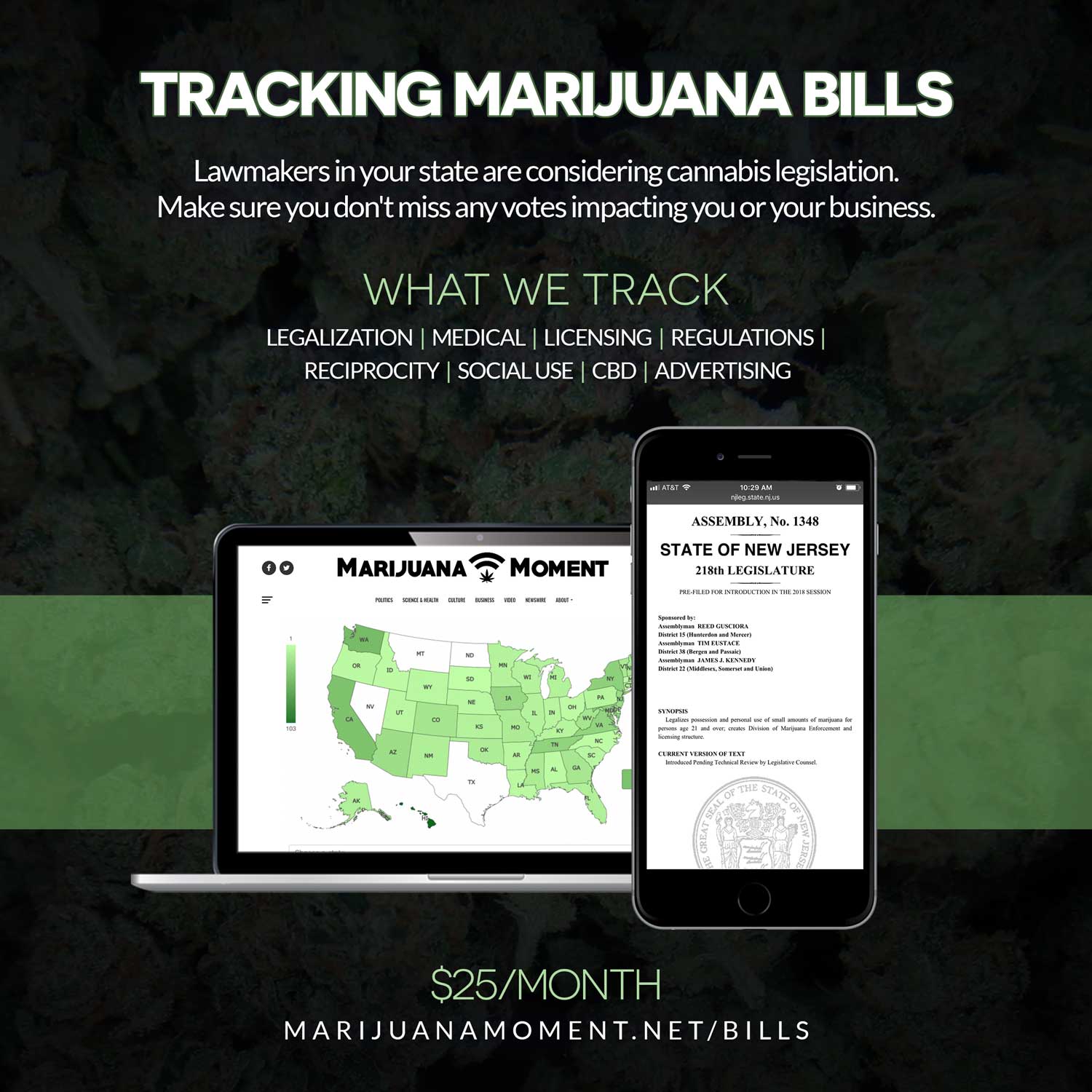
Learn more than virtually our marijuana beak tracker and become a supporter on Patreon to become admission.
—
At Monday's hearing, a representative of of the Koch-funded Americans for Prosperity, who besides has a child with autism, said that "we work every day to pause the barriers that inhibit individuals from realizing their full potential," and that includes pushing for an end to cannabis criminalization.
"By really passing medicinal cannabis in South Carolina, information technology gives u.s.a. the opportunity to open therapeutic treatments," she said, adding that the reform would ensure that "our police enforcement are able to focus on the crimes that are more than loftier, loftier level crimes."
Gov. Henry McMaster (R) said in February that it was too early to annotate on the proposal, as changes were still being made by lawmakers. "This is one that's going to depend on a lot of things," he told a local Pull a fast one on station, adding that he'll wait to see the final version before deciding whether he would potentially sign or veto the bill if if were to arrive on his desk.
S. 150 would allow patients with qualifying weather to possess and purchase cannabis products from licensed dispensaries. Smokable products, as well as home cultivation of cannabis by patients or their caretakers, would be prohibited. Simply possessing the plant form of cannabis could be punished as a misdemeanor.
Qualifying conditions for medical cannabis include cancer, multiple sclerosis, epilepsy, glaucoma, Crohn'south affliction, sickle cell anemia, ulcerative colitis, cachexia or wasting syndrome, autism, nausea in homebound or end-of-life patients, muscle spasms, post-traumatic stress disorder (PTSD). Terminal patients with less than a year to live would also qualify. However, regulators would be authorized to add additional atmospheric condition in the future.
The neb would also allow admission among patients with "any chronic or debilitating disease or medical status for which an opioid is currently or could be prescribed by a physician based on by and large accepted standards of intendance," for example astringent or persistent pain.
Medical marijuana would be bailiwick to the state'southward vi percentage sales revenue enhancement, and local jurisdictions would be able to levy an additional tax.
Rather than have conventional medical marijuana dispensaries that are in place in other legal states, the neb stipulates that there would be so-called cannabis pharmacies. The facilities would be required to have a pharmacist on site at all times, and the South Carolina Board of Pharmacy would promulgate concern regulations.
People with felony-level drug convictions would also be prevented from participating in the new industry for a period of 10 years under the proposal.
In-state businesses would also receive licensing priority when the market place in established, with the intent being to preclude multi-state operators from dominating the industry.
Under the bill, 75 per centum of tax acquirement subsequently expenditures would get to the land'south general fund, with another x percent going to drug employ disorder treatment service providers, five per centum going to country law enforcement, and the remainder going to cannabis research and drug education.
For the initial rollout, regulators would corroborate xv cannabis cultivators, 30 processing facilities, a cannabis chemist's shop for every 20 pharmacies in the country, five testing laboratories and 4 cannabis transporters. Lawmakers, rather than regulators, would exist authorized to approve boosted license types.
Local governments could ban medical cannabis businesses from operating in their jurisdictions under the amended bill, only otherwise the it says that local land use and zoning burdens "should be no greater for a cannabis-based business than for any other similar concern."
The state Department of Health and Environmental Control would oversee licensing and other regulations of the new manufacture. A newly established Medical Cannabis Advisory Board would be in charge of adding or removing qualifying weather condition. The board would meet at to the lowest degree once per year and be led past a governor-appointed chairperson.
Davis has championed medical marijuana in Southward Carolina since 2014, and at a rally earlier this year, he brought out a folder that he said contained eight years of research into the issue. He said he would employ the information to "take on every single argument that has been raised in opposition to this bill, and I'grand going to show that they cannot stand in the fashion of facts and evidence."
He'due south also continued to push button back against opposition to cannabis legalization from his own party, for case calling out an attack ad that was paid for by the Southward Carolina Republican Party.
The state GOP organization separately slammed a federal legalization bill from U.S. Rep. Nancy Mace, a Republican who represents South Carolina in Congress.
A former White House chief of staff under President Donald Trump also recently called out his home state South Carolina Republican Party for opposing the medical marijuana bill medical marijuana. Mick Mulvaney, Trump'southward superlative aide for more than than a year and a former congressman, called the legislation "something that merits word and reasoned assay," even if it's not a proposal that is conventionally considered a bourgeois priority.
Davis referred to the maneuvers past his own political party as "the elephant in the room" on the Senate flooring every bit fence on the floor kicked off in January, saying he was offended by the misinformation and planned to rebut every misleading claim the group made.
"I'grand going to go through every single legal argument that's been put up in that location—lack of medical evidence, unintended social consequences—and take them all up and discuss them and abnegate them," the senator said at the fourth dimension.
A poll released final Feb constitute that South Carolina voters support legalizing medical marijuana by a 5-to-1 ratio. Just the state does non have a citizen-led initiative process that has empowered voters in other states to get the policy change enacted.
Support for medical marijuana legalization amid South Carolina residents has been notably stable, as a 2018 Criterion Research poll similarly found 72 per centum support for the reform, including nearly two-thirds (63 per centum) of Republicans. Davis said last year that if the legislature didn't advance the reform, he'd propose a beak to put the question of medical marijuana legalization to voters through a referendum.
Also in 2018, 82 percentage of voters in the state's Democratic master election voted in favor of medical cannabis legalization in a nonbinding ballot informational vote.
Lawmakers prefiled four marijuana measures for the 2019 session, just they did not accelerate.
Maryland Lawmakers Hash out Senate-Passed Pecker To Fund Psychedelics Enquiry And Access For Veterans
Photograph courtesy of Brian Shamblen.

Source: https://www.marijuanamoment.net/south-carolina-lawmakers-hear-senate-passed-medical-marijuana-legalization-bill-in-committee/
Belum ada Komentar untuk "Anger Was the Emotion Among Voters When They First Heard That Their Tax Would Be Raised Again"
Posting Komentar