Many of the Athletes Come From Urban, Low Class Families, So They Could Help Support Their Family.
College Sports Are Affirmative Action for Rich White Students
Athletes are often held to a lower standard past admissions officers, and in the Ivy League, 65 percent of players are white.
Quick, think of a college athlete. Chances are the person who comes to listen is a football game or basketball thespian at a powerhouse Division I school similar Louisiana State University or the Academy of Kentucky. Possibly the player resembles, say, Joel Embiid, who turned a chiseled, 7-pes frame into a total-ride scholarship at the University of Kansas before ascending to NBA stardom.
But the typical educatee athlete more ofttimes plays a less blockbuster sport—lacrosse, perchance, or tennis—and in many cases comes from a well-to-do family unit that has shelled out thousands and thousands of dollars over the years to nurture a budding athletic talent. And a bulk of the time, they're white.
The most visible college athletes—the ones running beyond bar-TV screens or in full-color photographs on paper sports pages—tend to be black. Indeed, college football and basketball players skew disproportionately African American. But, says Kirsten Hextrum, a professor of educational leadership at the University of Oklahoma, "the black men in these ii sports are not the reality of who has access to college sports."
By the National Collegiate Athletic Association'south own estimate, 61 percent of student athletes last year were white. At aristocracy colleges, that number is even college: 65 per centum in the Ivy League, non including international students, and 79 percent in the Division III New England Small College Athletic Conference, which includes elite liberal-arts colleges like Williams College and Amherst Higher. Every bit Harvard heads to courtroom to fend off allegations that it discriminates confronting Asian American applicants, the plaintiffs backside the case accept released to the public reams and reams of information analyzing the schoolhouse'south admissions procedure. They criminate that one factor used in admissions, chosen "personal rating," systematically disadvantages Asian American students. But tucked into the 168-folio assay of Harvard'due south admissions data is a curious statistic about some other nonacademic factor considered by the school: athletics.
All applicants to Harvard are ranked on a scale of i to vi based on their academic qualifications, and athletes who scored a 4 were accustomed at a charge per unit of virtually seventy per centum. Nonetheless the acknowledge rate for nonathletes with the same score was 0.076 percent—nearly one,000 times lower. Similarly, 83 percent of athletes with a tiptop bookish score got an acceptance letter, compared with sixteen percent of nonathletes. Legacy admissions policies get a lot of flak for privileging white applicants, but athletes have a much bigger upshot on admissions, and make upwards a much bigger pct of the grade. And it'south non but Harvard—in 2002, James Schulman and former Princeton University President William Bowen looked at 30 selective colleges and plant that athletes were given a 48 percent heave in admissions, compared with 25 percent for legacies and 18 percentage for racial minorities.
Put another fashion, college sports at elite schools are a tranquility sort of affirmative action for affluent white kids, and play a big role in keeping these institutions so stubbornly white and affluent. What makes this all the more than perplexing, says John Thelin, a historian of higher education at the University of Kentucky, is that "no other nation has the equivalent of American college sports." Information technology'due south a particular quirk of the American higher-education system that ultimately has major ramifications for who gets in—and who doesn't—to selective colleges.
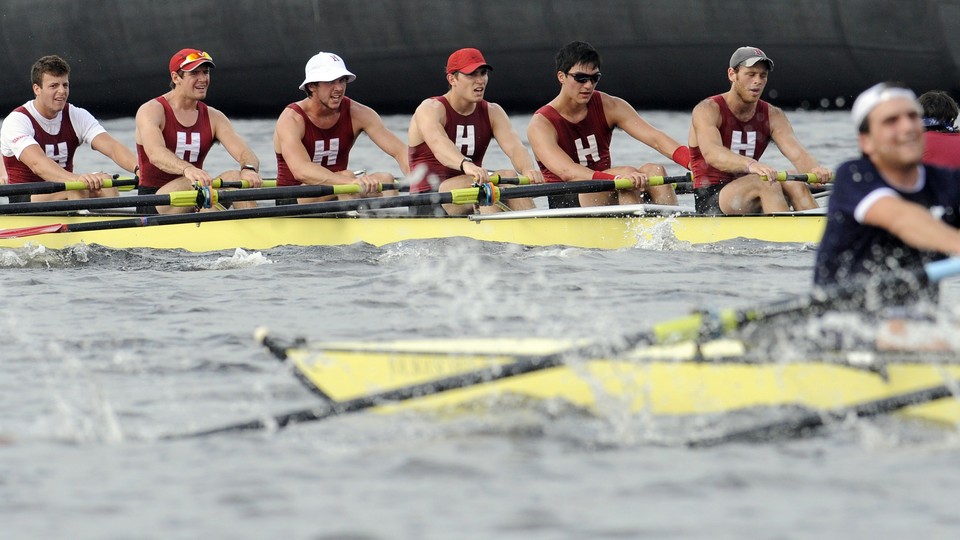
When information technology comes to higher athletics, football game and basketball command the most public attention, but in the groundwork is a phalanx of lower-profile sports favored by white kids, which often toll a small fortune for a student participating at a summit level. Ivy League sports like sailing, golf, water polo, fencing, and lacrosse aren't typically staples of urban high schools with big nonwhite populations; they take entrenched reputations equally suburban, country-club sports. According to the NCAA, of the 232 Segmentation I sailors terminal year, none were black. Eighty-five percent of higher lacrosse players were white, too as 90 percentage of ice-hockey players.
And the cost of playing these sports can exist sky loftier. "In that location are high economic barriers to entering in this highly specialized sports system," Hextrum says. "White people are concentrated in areas that are resource rich and have greater access to those economical resources." Getting expert enough at a sport to have a shot at playing collegiately often necessitates coaching, summer camps, traveling for tournaments, and a mountain of equipment. Ane in 5 families of an aristocracy high-schoolhouse athlete spend $one,000 a calendar month on sports—the average family of a lacrosse player spends almost $8,000 a year. Kids from low-income families participate in youth sports at well-nigh one-half the rate of flush families, according to a study from the Aspen Institute. It'south no surprise, and so, that per The Harvard Blood-red's annual freshman survey, 46.three percent of recruited athletes in the class of 2022 hail from families with household incomes of $250,000 or higher, compared with one-tertiary of the course as a whole.
But there are other, more than veiled factors that may also boost the numbers of white college athletes. For one, many elite colleges—including Ivy League schools and smaller Division III colleges—don't offer athletic scholarships, and then they can't requite depression-income sports stars a free ride similar big, Partitioning I schools tin can. Michele Hernandez Bayliss, a private college advisor and a former assistant admissions dean at Dartmouth College, walked me through the procedure: Over the summer, coaches compile lists of the athletes they want, which they and then share with the admissions office. "Most of the recruiting happens in the early rounds. In one case coaches have their listing, they would rather wrap upwards the whole process early rather than wait until the spring," Hernandez said. That the recruited athletes are called early on on is seemingly mundane, but information technology warps the process in favor of wealthier kids who can send in early-determination applications to selective schools without fretting about the size of the financial-help package they'll receive.
In a recently published study in the Harvard Educational Review, Hextrum interviewed 47 athletes at an unnamed elite, Division I college about how they earned a coveted spot at the university. As she writes, there are all sorts of hidden advantages that "secure greater access to elite colleges for white middle-class communities via athletic participation." Athletes often get noticed by making visits to the college and sending coaches intensely curated portfolios highlighting their prowess. Affluent kids, "due to their community and social networks, are improve at navigating this procedure," she told me. And in some cases, she constitute, cozy relationships betwixt high-school and higher coaches can facilitate admission for students: "There were instances where if you knew someone who knew someone, you could use that advantage to go a shortcut route into athletics."
At schools like the University of Alabama and Ohio State University with storied teams that gin up media attention rivaling the large leagues, athletics is a cash moo-cow: In 2017, the Ohio State athletics plan brought in $167 million in revenue. Yet, according to the NCAA, at all but 20 colleges, athletics programs lose more money than they make. That raises a baffling question: Why are colleges willing to lower their admissions standards to recruit the best athletes when their expensive sports programs are unlikely to render the investment?
For some colleges, information technology's a ploy to burnish their national reputation by getting their name out at that place, on the field or on the courtroom. And, in some cases, it works: After Florida Gulf Declension University made a David-and-Goliath-like run to the March Madness Sweet xvi in 2013, the schoolhouse saw a 27.5 percent spring in applicants the post-obit year.
Incidental marketing aside, sports can also brand a higher seem more attractive to its students. Athletics, Thelin says, "is 1 of the few unifying activities that can bring the school together. Football, particularly." And, he told me, higher sports can nurture loyalty to an establishment years afterwards a student leaves campus, and mayhap inspire i to donate coin to the school.
But how many people are really going to lacrosse games and sailing meets and the other sporting events that don't typically have graduates reaching for their checkbook? Part of it is the power of tradition: For more a century, colleges—starting with aristocracy schools in the Northeast—accept fixated on physical activity and sports as a way to mold young, impressionable students to their making. That continues today: "Potent academic colleges often like to at to the lowest degree offer the prospect of the sound mind, audio body," Thelin says. And, all the same, colleges need to field a minimum number of sports to join a particular conference, such equally the Ivy League, which prevents them from putting all their cards on the tabular array for loftier-profile sports exclusively.
As Harvard'due south admission policies go through the wringer, higher sports has largely evaded scrutiny, even amongst the plaintiffs accusing the school of discrimination. "People are complaining about minority students," Hernandez says, "just athletes are taking up almost a 5th of the class [at Harvard], and they're lowering the academic standards quite a bit."
Granted, athletes at aristocracy schools are far from brain-dead jocks—they work long, grueling hours to balance their academic workload with games, practices, and travel, and accept to maintain a certain grade point boilerplate to stay eligible to play their sport. Just, as the Harvard case seems poised to inch its mode to the Supreme Court, where a majority of justices could curl back affirmative action, it's worth considering how other admissions practices put a thumb on the calibration for white students. The processes that funnel rich white athletes to selective colleges aren't going anywhere in the curt term, merely in a possible future in which colleges can no longer consider race in admissions, at that place could be renewed public force per unit area for these schools to clear the musty cobwebs of the admissions process that undermine their cocky-proclaimed ethos as America's engines of social mobility.
"Information technology'south curious to me that these elite universities are belongings on to these policies, because I recollect they expose the contradictions of what universities do in admissions," says the Harvard professor Natasha Warikoo. "They're blatantly privileging already privileged groups."
Update: This article has been updated to remove identifying information about a student athlete, to protect his privacy.
Source: https://www.theatlantic.com/education/archive/2018/10/college-sports-benefits-white-students/573688/
Belum ada Komentar untuk "Many of the Athletes Come From Urban, Low Class Families, So They Could Help Support Their Family."
Posting Komentar